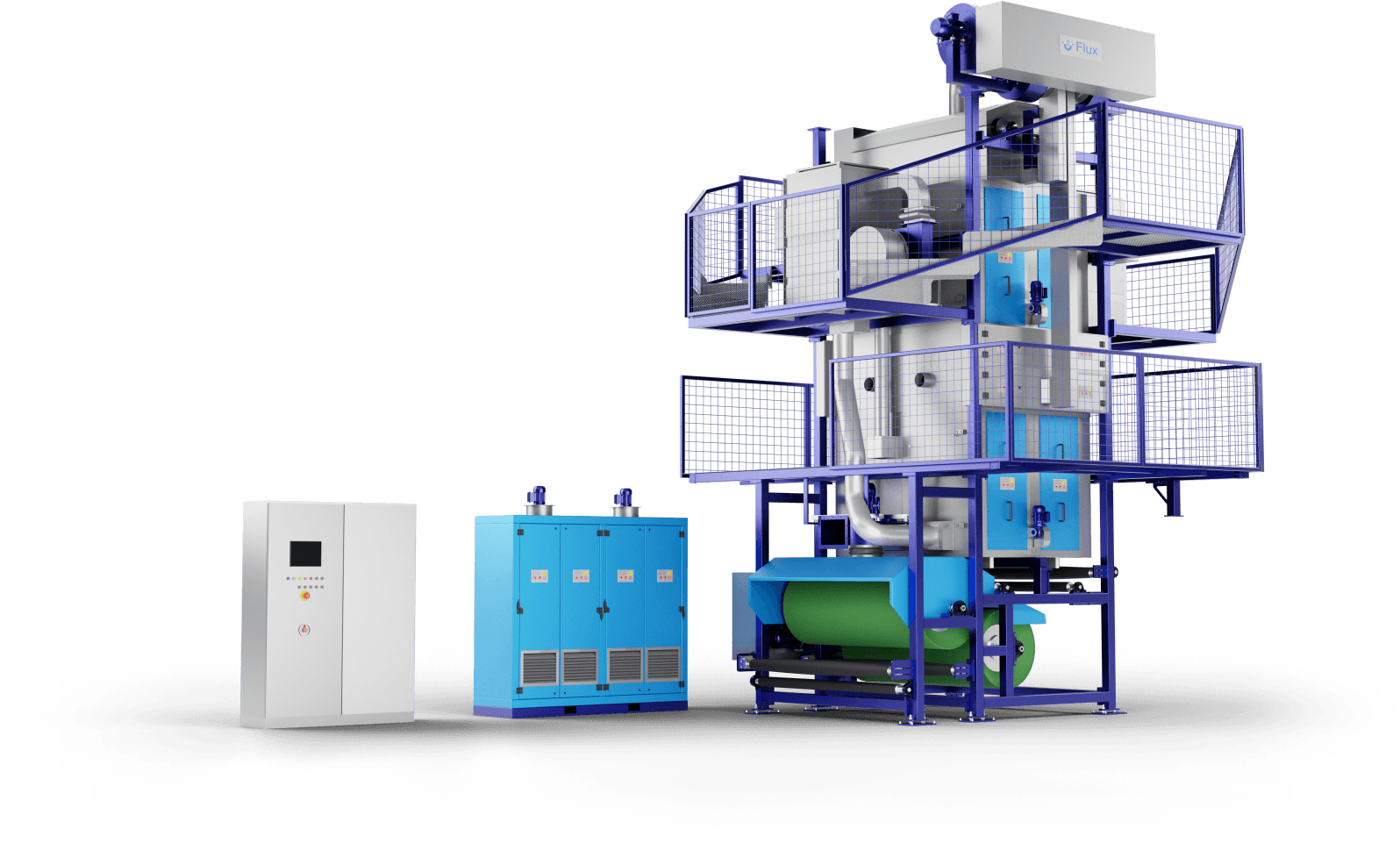
Inkjet Printing
FLUX - SMART DRYERS
Radio Frequency (RF) for Ink Drying
WHY USE RF FOR THE DRYING OF INK?
Currently, at the state-of-the-art of digital printers, printing equipment is designed for high-speed capacity. However, the potential of these machines is directly bonded to and limited only by the efficiency of the dryers.
The result is often an inefficient pair: a high-end, technological, and expensive printing machine matched with an inefficient, slow, and obsolete dryer. RF technology eliminates this bottleneck, aligning drying speeds with modern printing capabilities.
HOW THE TECHNOLOGY WORKS
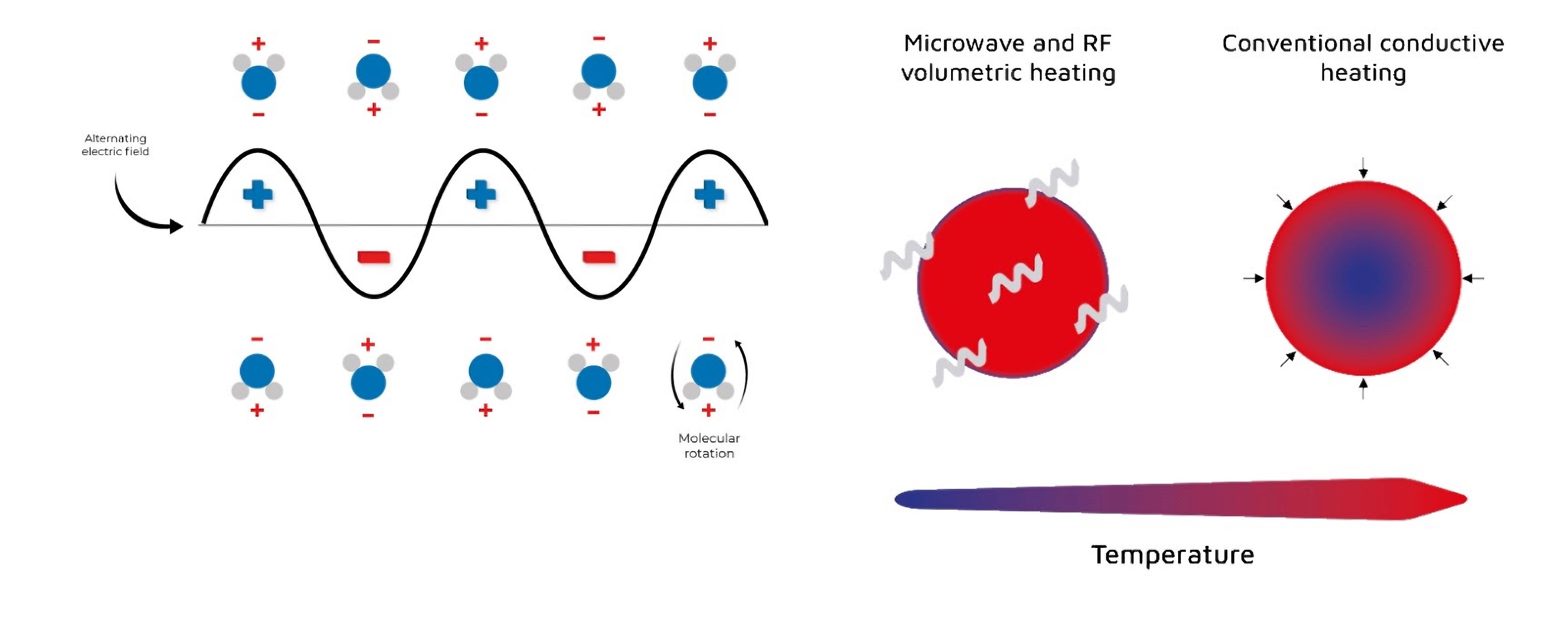
RADIO FREQUENCY technology is based on high-frequency electromagnetic fields to heat the water within the ink.
The Physical Process
- Molecular Vibration: When exposed to high-frequency waves, water molecules undergo vibration and rotation at a rate of millions of times per second.
- Internal Heat Generation: This molecular friction generates heat from the core, raising the water temperature to the point of evaporation.
Key Advantages
- Intrinsic Transfer: The heat transfer process is immediate throughout the entire product mass.
- Consistency: The drying process is "intimate," ensuring every part of the ink layer is treated simultaneously.
- Speed: Significantly faster than conventional surface-heating methods (like hot air or IR).
HOW THE TECHNOLOGY WORKS?
RADIO FREQUENCY technology is based on high-frequency electromagnetic fields to heat the water within the ink.
The Molecular Process
When exposed to high-frequency waves, water molecules undergo vibration and rotation at a rate of millions of times per second. This molecular friction generates heat directly from the core, raising the water temperature to the point of evaporation.
Core Advantages
- Intrinsic Transfer: The heat transfer process is immediate throughout the entire product mass.
- Uniformity: The drying process is "intimate," ensuring the ink is treated consistently from the inside out.
- Efficiency: Significantly faster than conventional surface-heating methods, as it does not rely on thermal conduction from the outside.
Why Conventional Methods are Inefficient Compared to RF
Currently, various technologies are used for ink drying, but even when applied efficiently, they face significant handicaps that limit their performance:
1. Forced Hot Air Dryers
These are the most common systems used for ink drying in digital printing, yet they present several critical drawbacks:
- High Energy Consumption: They require a high rate of electric energy to generate power through electric resistors or gas burners.
- Environmental Impact: This method has the highest environmental footprint due to significant thermal dispersion.
- Operational Inefficiency: Drying is slow and often uneven, making the equipment bulky, space-consuming, and expensive to operate.
2. Infrared (IR) and Ultraviolet (UV) Ray Dryers
While specialized, these radiation-based methods fail to provide a complete drying solution:
- Surface-Only Drying: IR and UV waves are unable to dry efficiently through the entire mass of the ink; the process occurs effectively only on the surface.
- Thermal Stress: These methods cause higher thermal dispersion into the environment and subject the ink to unnecessary thermal stress.
- Color Dependency: Drying is inconsistent because radiation absorption is directly affected by the specific colors of the ink within the visible spectrum.
Comparison Summary
Why Conventional Methods Fail vs. RF Technology
Currently, different technologies are used for ink drying, but even when applied efficiently, they face significant operational handicaps:
Comparison of Conventional Drying Technologies
Case Study: Energetic Consumption & Savings
Below is a comparative analysis of consumption on an operative production line (72-head printer) comparing a traditional dual-module hybrid dryer against our TIFFANY 20.
Case Study: South European Market (72-Head Printer)
Annual Savings: Over 30,000 EUR/year.
Note: This study was conducted in one of the most economical zones in Europe. Savings include a significant reduction in environmental thermal dispersion.
Case Study: Italy (16-Head Printer)
Comparison between a conventional single-module hot air dryer and the TIFFANY 10.
Key Conclusion
In the Italian study, we confirmed an annual saving of 14,000 EUR per unit. This represents a 60% cost reduction on the electric bill compared to traditional technology currently in use.
The FLUX Advantage
Low consumption and 100% Fully electric technology
The overall efficiency of the process is 2 to 3 times higher that conventional Infrared/Hot air/Gas technology. With an evaporation rate of 1,5Lt/hour of water for every Kw of RF power FLUX technology is the most efficient and money-saving method for the drying of ink.
No changes in colors and low thermal stress
The water extraction process involves a very mild and insignificant thermal transfer to the product and external environment, the transfer of the energy is provided with surgical precision to the water molecules only.
No emissions or polluting products
The technology is 100% electric and Carbon Free, does not require any filtering systems, environmental control nor use of disposable sources of power
High thermal efficiency, low environmental heating and elimination of preparation time
The drying of water based ink is processed instantly with RF, with negligible thermal losses and without any preparation or pre-heating time.